


*これは英語で書いた記事です。少しずつ日本語の投稿も増やしていく予定です。
The first time I visited Onomichi was in 2018.
On the little yellow train that was otherwise full of students in high school uniforms, I was one of just three adults — and I found myself quietly amused. I had visited Tokyo and Osaka many times, where the trains are packed with people of all shapes and ages, but here I was in a moment that felt more like a scene from an anime or a novel.
After we pulled into a small, charming Taisho-era station, I found myself swept along with the crowd, surrounded by excited conversations in a language I was only just beginning to understand. I stepped out to find the sea in front of me, a slope town behind me (was that… a castle?), and the entrance to a Shotengai just to my left. It felt like I had arrived somewhere different but wonderful.
Dragging my suitcase behind me as I walked through the covered shopping street, I found myself unable to stop smiling. Flowing like fish, students on bicycles passed, and that sensation — different but wonderful — stayed with me. It was a strange, beautiful nostalgia for things I had only ever seen in anime or heard about in stories.
At six o’clock in the evening, I was drenched in sweat despite the cool autumn weather. The guesthouse website had gently warned me that it was more than 300 steps up the hillside. I shifted my suitcase in my arms, pushed onward and then… temple bells began to toll.
A signal to pause.
I set the luggage down and pressed my brow into my sleeve, then turned. And the softly wondrous view, Onomichi in Twilight, welcomed me with the reminder to breathe, deeply.
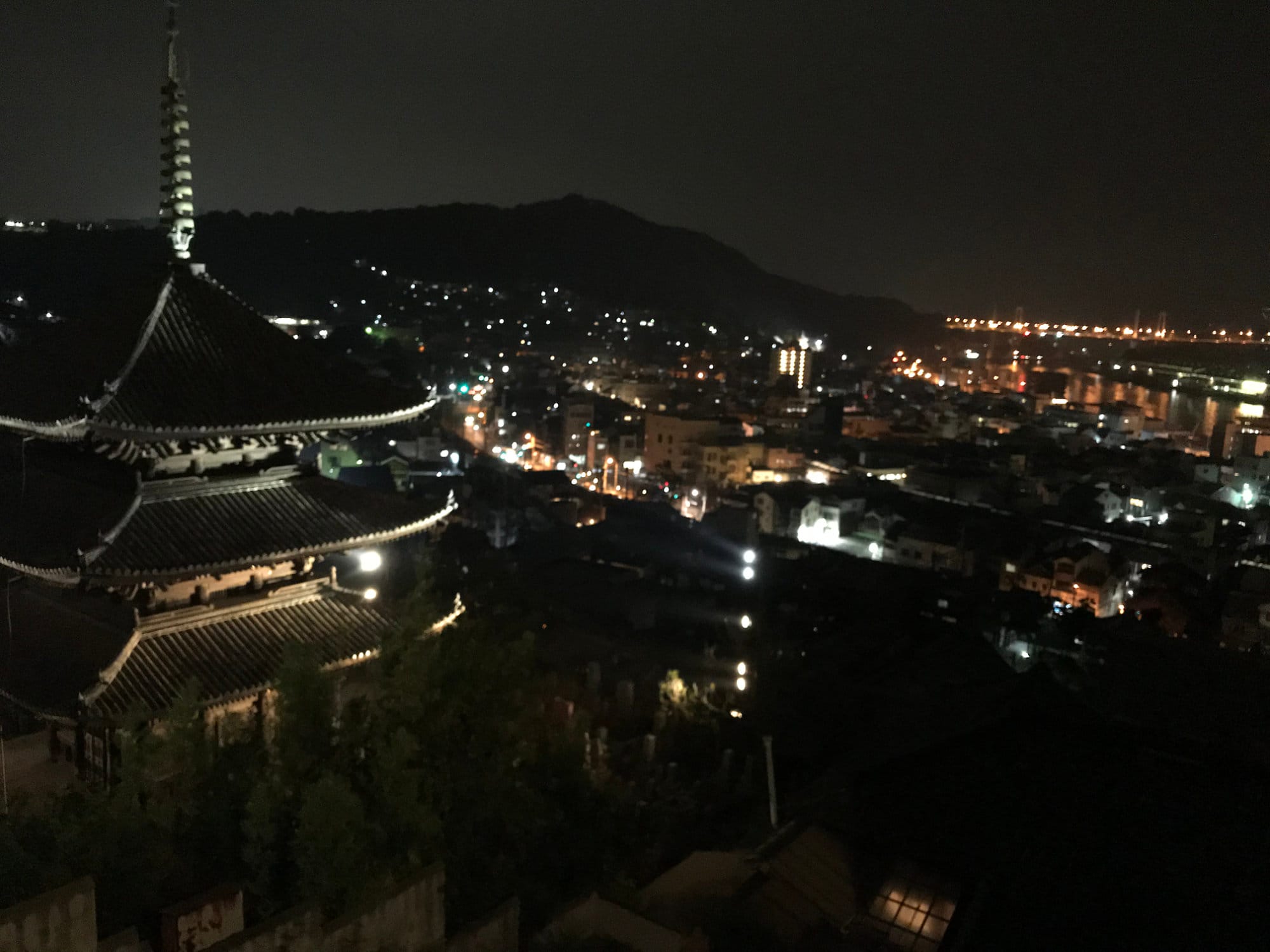
The nearby mountains of Mukaishima were melting into the still-deepening indigo sky, and lights on the ferries winked as they bobbed across the strait. Street lamps had come on and the windows in a few of the homes, spread upon the hill, were lighting. Among the shadows were larger shapes, like the three-tiered pagoda immediately to my left, temples centuries-familiar with this scenery, calling out to the hillside: breathe, deeply.
What WAS this place?
I and many others try to name what makes Onomichi special so we can explain it to others, or maybe find other similar places with these same qualities. The reasons are complex.
They include history, layout, human interactions, memories, light, sound, and rhythm, maybe.
But the reason I moved to Japan is simple: I fell in love with Onomichi.
I couldn’t imagine anywhere else I would rather be.
After that first trip, and visits before and after the pandemic, I moved here, Onomichi, Hiroshima, with hopes and dreams in my heart and experiences and skills in my back pocket.
This is where I want to be, this town on the hill and beside the sea, of temples and alleys and cats, where birds sing every morning and students pedal through the shopping street every day. There’s still much in Japan I want to discover, but the rhythms here drape intimately close to my heart. The people I’ve met here have been exceptionally kind. I am called by name on the street, I greet friends, and exchange smiles and nods with familiar faces. My feelings deepen every day.
I want to contribute something meaningful to these communities and people who have all been so kind. I want to offer the good things I’ve received in life, in hopes that they might be helpful, beneficial. I’m not from this town — but I love it deeply. I respect its hardworking people, its culture, its kindness, and its long, living history.
Among the many things that have shaped me, the physical practice of AcroYoga has been one of the most valuable.
I hope this practice can also bring something good to people here.
The first time I visited Onomichi was in 2018.
On the little yellow train that was otherwise full of students in high school uniforms, I was one of just three adults — and I found myself quietly amused. I had visited Tokyo and Osaka many times, where the trains are packed with people of all shapes and ages, but here I was in a moment that felt more like a scene from an anime or a novel.
After we pulled into a small, charming Taisho-era station, I found myself swept along with the crowd, surrounded by excited conversations in a language I was only just beginning to understand. I stepped out to find the sea in front of me, a slope town behind me (was that… a castle?), and the entrance to a Shotengai just to my left. It felt like I had arrived somewhere different but wonderful.
Dragging my suitcase behind me as I walked through the covered shopping street, I found myself unable to stop smiling. Flowing like fish, students on bicycles passed, and that sensation — different but wonderful — stayed with me. It was a strange, beautiful nostalgia for things I had only ever seen in anime or heard about in stories.
At six o’clock in the evening, I was drenched in sweat despite the cool autumn weather. The guesthouse website had gently warned me that it was more than 300 steps up the hillside. I shifted my suitcase in my arms, pushed onward and then… temple bells began to toll.
A signal to pause.
I set the luggage down and pressed my brow into my sleeve, then turned. And the softly wondrous view, Onomichi in Twilight, welcomed me with the reminder to breathe, deeply.
The nearby mountains of Mukaishima were melting into the still-deepening indigo sky, and lights on the ferries winked as they bobbed across the strait. Street lamps had come on and the windows in a few of the homes, spread upon the hill, were lighting. Among the shadows were larger shapes, like the three-tiered pagoda immediately to my left, temples centuries-familiar with this scenery, calling out to the hillside: breathe, deeply.
What WAS this place?
I and many others try to name what makes Onomichi special so we can explain it to others, or maybe find other similar places with these same qualities. The reasons are complex.
They include history, layout, human interactions, memories, light, sound, and rhythm, maybe.
But the reason I moved to Japan is simple: I fell in love with Onomichi.
I couldn’t imagine anywhere else I would rather be.
After that first trip, and visits before and after the pandemic, I moved here, Onomichi, Hiroshima, with hopes and dreams in my heart and experiences and skills in my back pocket.
This is where I want to be, this town on the hill and beside the sea, of temples and alleys and cats, where birds sing every morning and students pedal through the shopping street every day. There’s still much in Japan I want to discover, but the rhythms here drape intimately close to my heart. The people I’ve met here have been exceptionally kind. I am called by name on the street, I greet friends, and exchange smiles and nods with familiar faces. My feelings deepen every day.
I want to contribute something meaningful to these communities and people who have all been so kind. I want to offer the good things I’ve received in life, in hopes that they might be helpful, beneficial. I’m not from this town — but I love it deeply. I respect its hardworking people, its culture, its kindness, and its long, living history.
Among the many things that have shaped me, the physical practice of AcroYoga has been one of the most valuable.
I hope this practice can also bring something good to people here.